
Curtainless X-ray inspection eliminates traditional lead-free curtains to prevent jamming and cross-contamination risk (associated with residue transfer between products) on lightweight, unpackaged, or unsealed products. Radiation safety is maintained through tunnel depth, internal shielding, and conveyor design, keeping leakage below 1 µSv/h while enabling higher throughput and easier sanitation.
X-ray inspection has long been the gold standard for detecting foreign objects and protecting product safety in the food processing, packaging, and pharmaceutical industries. Most systems use dense metal-based curtains to contain radiation and protect employees on the manufacturing floor.
But not every product moves easily through these systems. Lightweight packages, jars, bulk items, and delicate products can struggle at curtain entry and exit points, leading to inefficiencies or product handling issues.
That’s why curtainless X-ray inspection was developed, a specialized solution designed for applications where curtains create more challenges than benefits.
What Is Curtainless X-ray Inspection?
In curtainless X-ray inspection, radiation is safely contained using a geometrically optimized, integrated shielding system, eliminating the need for heavy curtains and allowing products to pass through smoothly while maintaining full detection accuracy.
Conventional X-ray inspection systems rely on shielding curtains, typically made from dense, metal-impregnated rubber, to contain radiation and protect operators. While highly effective at preventing radiation leakage, curtains can present challenges for certain product types.
Lightweight snack bags, delicate bakery trays, bulk products like nuts or coffee beans, and rigid containers such as jars or bottles may snag, topple, or jam when moving through curtains. For high-speed lines, these disruptions can create costly downtime and inefficiencies. Worst case, you may have purchased a standard X-ray system only to find out it cannot be used with your product type.
Curtainless technology addresses these issues with intelligent shielding designs that maintain safety and accuracy without relying on heavy curtains.
How X-ray Inspection Works Without Curtains
CASSEL’s curtainless X-ray systems are designed and engineered to safely contain radiation while keeping products moving seamlessly. This is achieved through:
- Internal shielding designs that use strategic angles to direct and contain radiation safely within the X-ray system.
- Narrow beam geometry that limits X-ray scatter in the inspection area.
- Physical enclosures and metal barriers that add layered protection.
- Low-energy emissions precisely focused where detection is needed.
Traditional X-ray curtains work by blocking the direct line of sight between the X-ray source and the external environment. Curtainless X-ray inspection achieves the same outcome through tunnel depth, internal shielding geometry, and controlled beam angles that prevent radiation from traveling in a straight path out of the inspection zone. By forcing X-rays to change direction and dissipate within shielded enclosures, radiation leakage remains well below regulatory limits without requiring physical curtains at the infeed or outfeed.
By replacing heavy curtains with built-in shielding, curtainless X-ray systems ensure both radiation safety and inspection accuracy, without the friction, snagging, or delay associated with curtains.
What Products and Industries Benefit Most from Curtainless X-ray Inspection?
Some of the most common applications and products that would benefit from curtainless X-ray inspection include:
- Delicate bakery products – Bakery items like brownie trays, pastries, and breads can be damaged or disrupted when pushed against heavy curtains. Curtainless inspection keeps these products intact while still ensuring contaminant detection.
- Bulk items like coffee beans, nuts, and seeds – Loose, free-flowing products can stick to or be contaminated by curtain material. An open design ensures smooth transfer and reduces the risk of contamination.
- Lightweight snack packages – Individual serving bags of potato chips, snack packs, or sachets are especially prone to snagging or getting caught in heavy curtains. Curtainless X-ray allows them to pass freely while maintaining consistent imaging.
- Jars, bottles, and cans – Tall or rigid containers, such as ketchup jars or canned goods, can be knocked over by heavy curtains. A curtainless design keeps these products upright and flowing smoothly.
- Pharmaceutical vials – Small, lightweight vials used in pharmaceutical manufacturing can be sensitive to the drag of heavy curtains. Curtainless systems ensure these high-value products are inspected accurately without risking tip-overs or contamination.
- Cannabis products – Pre-rolls, edibles, or other lightweight cannabis packaging can snag, tip, or jam behind curtains. Curtainless systems allow for seamless inspection while protecting product integrity.
CASSEL Curtainless X-ray Systems for F&B Production Environments
Curtainless X-ray inspection is most valuable when it’s matched to the right application. Below are two examples of how CASSEL XRAY SHARK Curtainless X-ray systems are designed to handle products that traditionally struggle with heavy curtains.
Bulk Products – X-ray SHARK Bulk
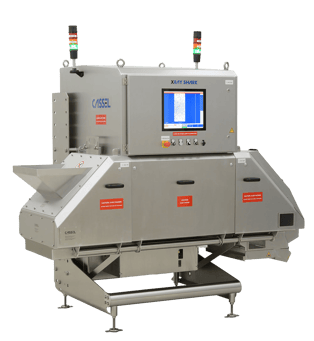 For free-flowing items like coffee beans, nuts, and seeds, traditional curtains can cause problems. Product can stick to or push against the curtain material, leading to contamination risks or production slowdowns.
The X-ray SHARK Bulk eliminates this issue with a curtainless design that allows bulk products to move freely while still delivering highly accurate contaminant detection. Its open flow design is ideal for manufacturers moving large volumes of loose product quickly and safely.
Cans, Jars, and Bottles – X-ray Side View
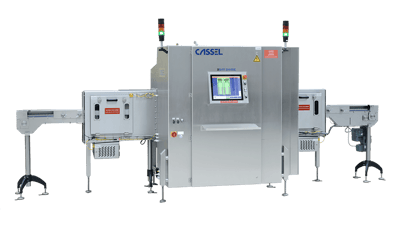 Tall or rigid packaging, such as ketchup jars, beverage bottles, or canned goods, can tip over when forced through heavy shielding curtains. CASSEL’s Side View X-ray system solves this problem by inspecting products from the side instead of pushing them through a curtain barrier.
Its unique zig-zag and angled shielding design creates an internal geometric barrier that prevents scattered X-ray leakage while maintaining operator safety. This approach keeps jars, bottles, and cans upright, reduces downtime from spills, and ensures complete detection coverage across the container’s contents.
CASSEL curtainless X-ray systems use intelligent shielding geometry, angled barriers, and physical enclosures to contain radiation within the detection area. Narrow beam designs and internal zig-zag shielding paths ensure scattered X-rays are blocked before they can escape.
Instead of heavy curtains, CASSEL curtainless x-ray systems use intelligent shielding geometry, angled barriers, and physical enclosures to contain radiation within the detection area. Narrow beam designs and internal zig-zag shielding paths ensure scattered X-rays are blocked before they can escape.
How Does Curtainless X-ray Inspection Meet Safety Standards?
A common question about curtainless X-ray inspection is simple: without curtains, is it safe? After all, shielding is what protects operators on the manufacturing floor from harmful radiation exposure.
CASSEL Inspection designs its curtainless systems with safety as a core feature. In many regions around the world, local authorities will test and certify each machine during installation. Every CASSEL unit is engineered to meet or exceed the strictest global safety standards, including the following:
- FDA 21 CFR 1020.40 – U.S. regulations for radiation-emitting products
- EN 61010 – European standards for general machine safety
- ANSI/HPS N43.3 – Safety requirements for non-medical X-ray
- UNE 7332 – X-ray safety regulation and test standard in Spain
- Bureau Veritas – Agency that certifies X-ray system safety in France
- AERB – Guarantees all safety, shielding, and operational standards are met to protect patients and workers from radiation hazards
Curtainless X-ray inspection can even improve safety on the production floor. By eliminating the jams and tip-overs that sometimes occur when lightweight, delicate, or bulk products interact with heavy curtains, operators face fewer interruptions and require less manual intervention.
The result is a system that not only maintains radiation safety but also enhances workplace efficiency and operator confidence.
How Do I Know If Curtainless X-Ray Is Right for My Application and Product?
You should consider curtainless X-ray if your products are lightweight, flexible, delicate, or prone to tipping, making it difficult for them to pass smoothly through heavy curtains. In these cases, a curtainless design can improve inspection accuracy, reduce downtime, and keep production moving efficiently.
Curtainless X-ray inspection is typically chosen when quality teams are troubleshooting frequent product jams, product presentation issues, or hygiene challenges on unpackaged or lightly packaged foods.
In internal CASSEL evaluations, lightweight products showed fewer entry disruptions when curtain contact was minimized, supporting the use of curtainless or low-contact designs for these applications.
At CASSEL, every product purchase begins with a detailed facility assessment. Our team evaluates your products, packaging, and production line before making any recommendations, ensuring that you invest in the X-ray solution best suited for your application.
In addition, every CASSEL X-ray machine can be optimized and customized for your line, whether curtained or curtainless. From beam geometry to shielding design, each system is tailored to fit your process and deliver reliable inspection results.
Final Considerations Before Procurement and Quality Assurance Teams Choose a Curtainless X-ray System
Below are some other considerations when deciding if a curtainless X-ray system is right for your application:
- Total cost of ownership – Consider not only the upfront investment, but also long-term savings from reduced downtime, easier cleaning, and fewer product jams.
- Warranty, service, and support – With CASSEL, every X-ray system is backed by expert service, technical support, and training to keep your operations running smoothly.
- Integration with existing lines – Curtainless and curtained X-ray systems can be tailored to fit seamlessly into your production line, ensuring minimal disruption and maximum efficiency.
By weighing these factors and partnering with CASSEL, procurement and QA teams can make confident, informed decisions that deliver long-term value, safety, and performance.
Curtainless X-ray Inspection FAQs
Let’s Find the Right X-ray System for You
CASSEL Inspection is more than an equipment provider, we’re a trusted partner for news, education, and expert guidance in contaminant inspection. Whether you’re exploring how food contamination can impact your brand or seeking advice on the right inspection technology for your production line, our team is here to support your safety and quality goals.
We continually refine our systems to meet the evolving needs of manufacturers, which is why we offer both traditional and curtainless X-ray solutions. Our curtainless designs give you new flexibility for handling lightweight, bulk, and delicate products without compromising safety or accuracy.
If you’re ready to see how curtainless X-ray could fit into your process, let’s start with a conversation. Contact CASSEL today.
